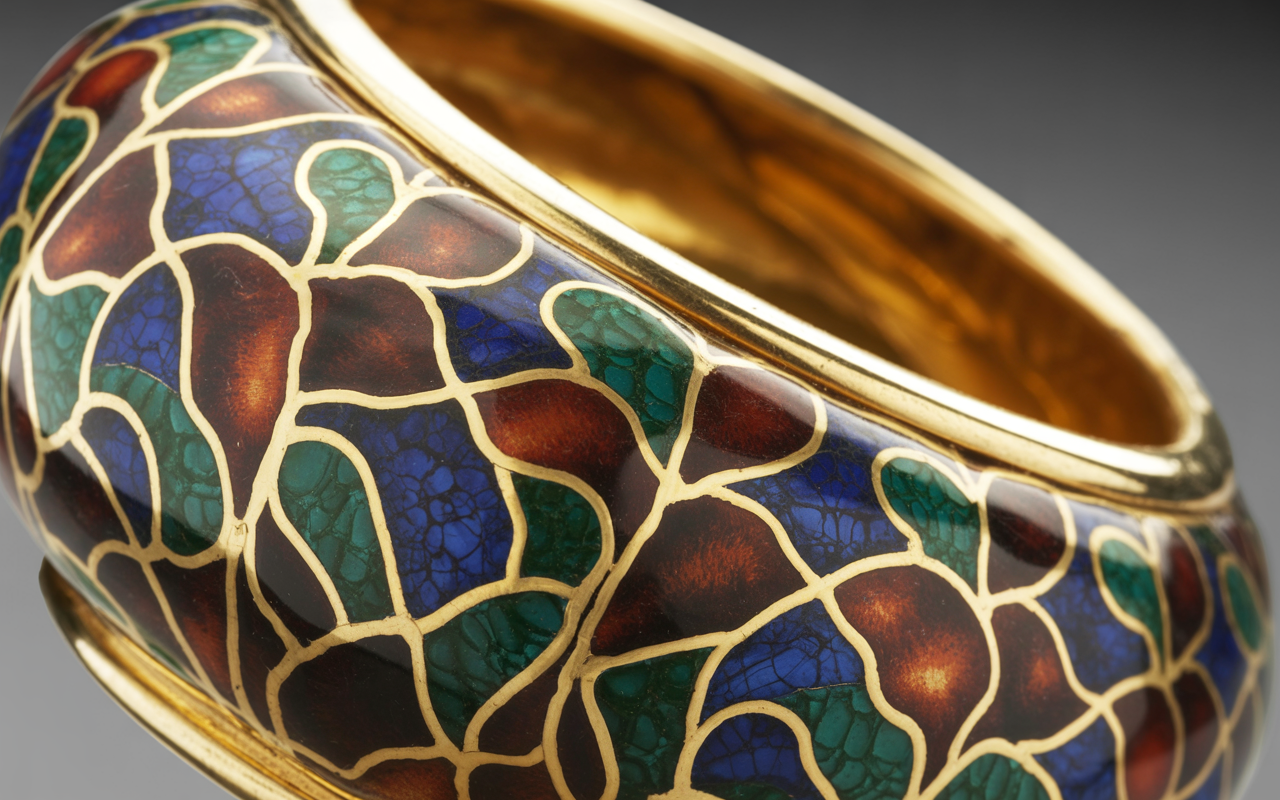
When Technique Becomes Vision: The World's Most Demanding Jewelry Art Form
There are perhaps two dozen artists working in the world today who have truly mastered gold cloisonné enamel at the highest level. William Harper is among the rarest of that rare group — and by most accounts, he stands apart even within it. For more than six decades, Harper has approached cloisonné enamel jewelry not as a craft to be perfected but as a language to be invented, refined, and ultimately transcended. The result is a body of work that occupies a singular position in the history of American art jewelry: technically unimpeachable, visually arresting, and intellectually alive in ways that most decorative objects never achieve.
To understand why Harper's work commands the attention of major museum curators, serious collectors, and art historians, it helps first to understand what cloisonné enamel actually demands — and why so few artists ever master it completely.
The Ancient Origins of Cloisonné Enamel Jewelry
Cloisonné enamel jewelry has one of the longest and most geographically diverse histories of any art form. Its earliest documented examples appear in ancient Cyprus and Egypt, dating to roughly 1,300 BCE, where craftsmen first discovered that powdered glass fused to metal under extreme heat could produce colors of extraordinary permanence and brilliance. The technique reached its first great flowering in the Byzantine Empire, where gold cloisonné enamel became the defining visual language of imperial and ecclesiastical luxury — an art form so closely associated with divine authority that its production was, at certain periods, restricted to imperial workshops in Constantinople.
Chinese artisans adopted and transformed the technique during the Yuan Dynasty, developing the bold, large-scale cloisonné objects that would define the form for centuries in East Asia. Japanese craftsmen later pushed the technique toward extraordinary refinement during the Meiji period, producing enamel work of almost hallucinatory delicacy. In Europe, Fabergé's workshops elevated cloisonné enamel to the status of high art in the late nineteenth century, cementing its association with luxury, permanence, and extraordinary skill.
What unites all of these traditions is the fundamental understanding that cloisonné enamel jewelry is not merely decorative. It is, at its best, a form of painting in glass — one that happens to be permanent, luminous, and capable of surviving centuries without degradation. It is this combination of visual richness and material durability that has made the technique a vehicle for the most important objects in cultures across the world.
The modern art jewelry movement of the mid-twentieth century brought cloisonné enamel into dialogue with contemporary fine art, freeing it from its historical associations with religious iconography and imperial decoration. Artists like Harper, who came of age during this transformation, inherited both the full weight of the technique's ancient history and the liberating possibilities of the contemporary art world.
Understanding the Enamel Jewelry Technique: A Process of Extraordinary Complexity
To appreciate what makes cloisonné enamel jewelry so demanding — and why truly accomplished work in the medium is so rare — it is worth understanding the technique in some detail.
Forming the Cloisons: The Architecture of Color
The process begins with fine gold wire, typically 24-karat fine gold or high-karat alloys, which the artist draws, shapes, and bends by hand into the intricate cellular partitions known as cloisons — from the French word for "partitions." These wire walls, which may be no more than a fraction of a millimeter in height, are arranged on a metal base to create the design's architecture. Each cell will ultimately hold a single color of enamel, and the precision with which these partitions are placed determines the precision of every color boundary in the finished work.
This stage alone can take days or weeks for a complex composition. The wire must be bent with absolute accuracy; there is no meaningful way to correct errors once the piece advances to firing.
Filling with Ground Glass Enamel
Once the cloisons are in place — typically secured with a fine layer of counter enamel fired to the back of the base — the artist fills each cell with finely ground glass enamel. These powdered glasses come in hundreds of colors, each with its own chemical composition, melting point, and behavior under heat. An experienced artist learns the personality of each color the way a painter learns the behavior of different pigments. Some colors are stable and predictable; others shift, bleed, or lose their brilliance if fired even slightly too long or too hot.
The enamel is applied wet, packed carefully into each cell, and then dried before firing.
Multiple Kiln Firings at Extreme Temperatures
The piece then enters the kiln, where temperatures reach between 1,400 and 1,500 degrees Fahrenheit. At these temperatures, the powdered glass melts, fuses, and bonds to the metal. The piece is removed, inspected, and the cells are refilled — because enamel shrinks as it fires. This cycle of filling, drying, and firing is repeated multiple times, sometimes dozens of times for a single piece, until the enamel is flush with the tops of the gold wire partitions.
Each firing is a moment of irreversible commitment. The heat can crack the enamel, warp the metal, cause colors to shift unexpectedly, or destroy hours of work in seconds. There is no undo function in cloisonné.
Grinding and Polishing to Completion
Once the enamel has been built up to the desired level, the surface is ground flat using progressively finer abrasives — a process that requires patience, skill, and an intimate understanding of how the glass will respond to abrasion. Finally, the surface is polished to the artist's desired finish: some prefer the soft, matte quality of stone-ground enamel; others bring the surface to a mirror-like brilliance that makes the colors appear to glow from within.
The gold wire partitions, now revealed as crisp lines of pure metal, become both the drawing and the frame — simultaneously structural and expressive.
William Harper's Approach: Reinventing a Millennium-Old Technique
What separates William Harper from even the most technically accomplished practitioners of cloisonné enamel is not merely his command of the process — though that command is absolute — but his refusal to treat technical mastery as an end in itself.
Combining 24-Karat and 14-Karat Gold
Harper works simultaneously with 24-karat fine gold and 14-karat alloys, exploiting the distinct visual and physical properties of each. Fine gold has a warmth and depth of color that no alloy can replicate, and its malleability makes it ideal for the most intricate wire work. The harder alloys provide structural integrity and a different surface quality. By combining them within a single piece, Harper creates works with an internal visual complexity — a sense of different metals in dialogue — that is entirely his own.
Precious Gemstones and Mixed Media
Harper's gold enamel brooches and sculptural jewelry objects frequently incorporate precious and semi-precious gemstones, natural pearls, shells, coral, and found objects. These inclusions are never decorative afterthoughts; they are integral to the narrative and visual logic of each piece. A baroque pearl might serve as the body of a figure; a fragment of ancient glass might become an eye; a piece of fossilized material might anchor a meditation on time and transformation.
This integration of mixed media into cloisonné enamel jewelry is technically demanding in ways that are easy to underestimate. Each additional material introduces new constraints: different thermal expansion rates, different sensitivities to heat, different requirements for setting and securing. Harper navigates these constraints with the confidence of an artist who has spent decades understanding exactly what each material will and will not do.
Narrative Jewelry as Fine Art
Perhaps most distinctively, Harper creates what might best be described as narrative jewelry — art jewelry objects that carry explicit intellectual and emotional content, that reference art history, mythology, personal biography, and spiritual inquiry. His pieces have titles. They have subjects. They reward sustained looking in the way that paintings reward sustained looking, revealing new details, new relationships, and new meanings with each encounter.
This commitment to content over pure formal beauty is what places Harper's work firmly in the tradition of fine art rather than decorative craft — and it is what has made his collectible art jewelry of enduring interest to museum curators and serious collectors.
Why Collectors Value Cloisonné: The Investment Case for Museum-Quality Jewelry
The market for investment quality art jewelry has matured significantly over the past two decades, and cloisonné enamel work by major artists has been among the most consistently appreciated categories within it.
Time, Skill, and Irreplaceability
A single William Harper brooch may represent between 40 and 200 or more hours of work — and that figure accounts only for the making, not for the decades of practice that make the making possible. The enamel jewelry technique at this level cannot be meaningfully mechanized or delegated. It is entirely hand-made, entirely dependent on the artist's accumulated knowledge, and entirely irreplaceable once the artist is no longer working.
This irreplaceability is the foundation of the investment case. Luxury handmade jewelry of this caliber does not become more common over time; it becomes less so.
Museum Validation Across 35+ Permanent Collections
Harper's work is held in the permanent collections of more than 35 major museums, including the Metropolitan Museum of Art, the Smithsonian American Art Museum, the Museum of Arts and Design, the Victoria and Albert Museum, and the Cleveland Museum of Art, among many others. This level of institutional validation is extraordinary for any living artist working in any medium, and it provides a foundation of scholarly and curatorial consensus about the work's significance that is invaluable for collectors.
Museum quality jewelry of this caliber carries a different kind of provenance than commercial fine jewelry. It exists within an art historical discourse, is subject to scholarly analysis, and appreciates in the context of a recognized artist's career trajectory.
Price Appreciation and Market Trajectory
Works by Harper that entered private collections in the 1980s and 1990s have appreciated substantially, consistent with the broader market recognition of American studio jewelry as a serious collecting category. As the field has gained institutional support and critical attention, early and significant works have become increasingly difficult to acquire — a dynamic that typically supports continued price appreciation.
The NYC Studio: Where the Work Is Made
Harper maintains his working studio in Upper Manhattan, where he continues to produce new work with the same intensity and commitment that has characterized his practice since the 1960s. The studio is not a showroom or a commercial gallery; it is an active working environment where the processes described above unfold daily.
Private viewings of available works are offered by appointment, providing collectors with the rare opportunity to encounter pieces in the context in which they were made, and to discuss the work directly with the artist. These appointments are unhurried and substantive — conversations about the work, its sources, its making, and its place within Harper's larger artistic project.
For collectors serious about acquiring museum quality jewelry with genuine art historical significance, there is no substitute for this kind of direct engagement with both the work and the artist.
A Living Legacy in Glass and Gold
William Harper's six decades of work in gold cloisonné enamel represent one of the most sustained and ambitious achievements in the history of American art jewelry. He has taken a technique with roots in ancient Byzantium and imperial China and made it entirely, unmistakably his own — pushing it toward new expressive possibilities while honoring the extraordinary discipline it demands.
For collectors who understand that the most compelling objects are those that reward both the eye and the mind, Harper's work offers something increasingly rare: luxury handmade jewelry NYC that functions simultaneously as wearable object, fine art, and historical artifact.
To explore currently available works or to arrange a private studio viewing, contact the studio directly to schedule an appointment. The collection is limited, the work is irreplaceable, and the conversation is always worth having.
